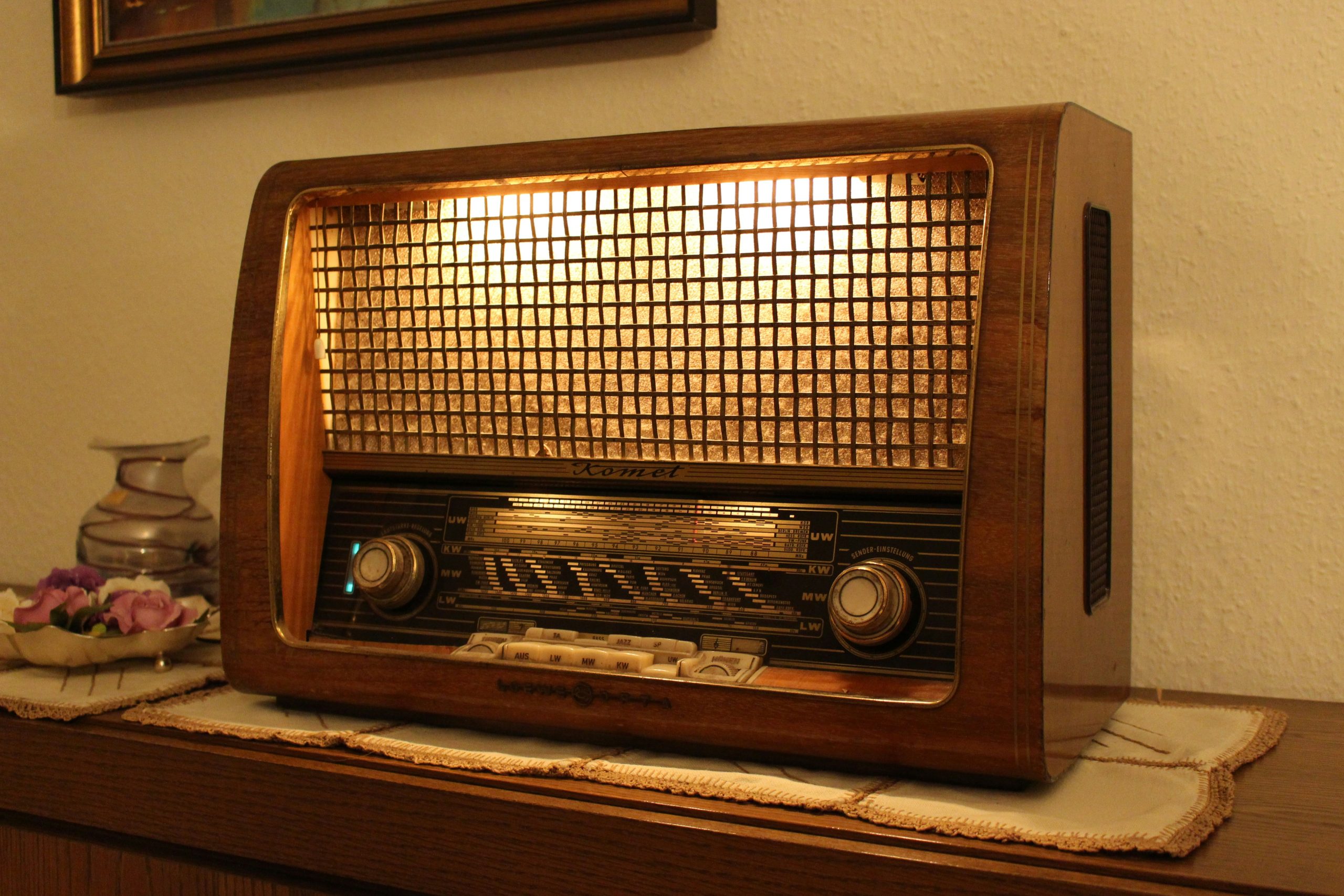
This article sits at the intersection of three of my obsessions: old-time radio, history, and genealogy. For about thirty years I’ve been a fan of the radio dramas and comedies of the 1930s and ’40s — Fibber McGee and Molly, Jack Benny, and Canadian shows like The Happy Gang and This Is Canada — the perfect companions for long drives across Canada. But a series that recently caught my attention was a piece of wartime propaganda called Nazi Eyes on Canada, and at the heart of it is the mystery of an episode that has simply vanished.

First, the background. Nazi Eyes on Canada was a radio series broadcast by the CBC and sponsored by the National War Finance Committee, the body established by the Minister of Finance on 7 January 1942 to run the Victory Bond campaigns and drum up voluntary savings for the war effort. The series is a textbook example of wartime propaganda — and I use that word neutrally. Propaganda is just the communication of ideas designed to persuade people to think and act a certain way, and an essential feature of it is that it rarely tells the whole truth. Nazi Eyes fits that description exactly.
Scholars sometimes split propaganda into “white” and “black.” White propaganda comes from a clearly identified source — the CBC, the National Film Board, the BBC. Black propaganda hides its origin, so the listener either can’t tell where it’s coming from or is actively misled. Nazi Eyes is plainly white propaganda: we know the CBC made it and the War Finance Committee paid for it. (Hold that distinction; a piece of black propaganda is lurking in this story too.)
The series aired in September and October 1942 at a moment when an Allied victory was anything but certain. In his study Twelve Turning Points of the Second World War, P.M.H. Bell places that autumn right at the hinge of the conflict — the end of the Axis high-water mark and the very beginning of the Allied recovery. Churchill caught the same mood on 10 November 1942, just after El Alamein, with his famous line that it was “not the end… but perhaps the end of the beginning.” Nazi Eyes didn’t change the course of the war, but it was broadcast when nobody yet knew how the war would end.
The format was consistent and, frankly, chilling. Each Sunday-night episode was hosted by a well-known American actor — Vincent Price, Orson Welles, Helen Hayes, Quentin Reynolds— who introduced a real Canadian family, sometimes by name and street address. We first see the family in a cozy setting, discussing the war over dinner. Then the scene jumps five years into the future, to a Canada that has lost the war and fallen under Nazi rule. The same families are shown suffering, wishing they had done more. At the end, the real Canadians being portrayed were invited to react — meaning that somewhere in these recordings are the actual voices of ordinary 1942 Canadians.
Two refrains recur: “Nazi eyes on Canada must never become Nazi feet in Canada,” and “Open your Victory Loan next week.”
Now, the black propaganda. The series repeatedly credits its inspiration to a real Nazi spy and propagandist named Colin Ross and his 1934 book Zwischen USA und dem Pol (“Between the USA and the Pole”). Ross spent much of the 1930s touring North America promoting a “Pan-American” vision in which, as the New York Times reported, the Germans were the only true bearers of the Pan-American ideal; an officer of the Stuttgart propaganda institute, he believed American democracy would soon collapse and let the Nazis take over. So Nazi Eyes — white propaganda — was built atop the writings of a black propagandist, scripted for the CBC by Alan King under producer J. Frank Willis.
Was anyone actually listening? Happily, yes. The Bank of Canada archives preserve an October 1942 audience survey by the firm Elliott-Haynes, and it shows Nazi Eyes ranking fifth among commercial programs — extraordinary company for a homegrown propaganda series:
1. Lux Radio Theatre
2. Jack Benny
3. Charlie McCarthy
4. Fibber McGee and Molly
5. Nazi Eyes on Canada
...
10. NHL Hockey
Before anyone is scandalized to see hockey languishing at number ten, remember that the 1942–43 NHL season didn’t start until 31 October.
Did all those listeners actually buy bonds? Impossible to say — too many other campaigns were running at once — but Nazi Eyes aired during the Third Victory Loan, which hit 132% of its $750-million target. Not everyone was charmed: Alberta Premier William Aberhart, quoted in the Regina Leader-Post of 27 October 1942, snapped, “What are they trying to do to us? Scare us into supporting the war effort?” Given that all this aired only four years after Orson Welles’s War of the Worlds panic, he had a point.
Which brings me, at last, to the missing episode — the reason this piece has the title it does. The primary source I worked from contains only five episodes of Nazi Eyes. There is a sixth that is missing: the one set in Québec, broadcast on 27 September 1942, featuring the parish of Sainte-Jeanne-de-Chantal on Île Perrot near Montréal, with the American stage star Bert Lytell. We know it existed and we know when it aired, but the recording itself is gone — lost, or sitting forgotten in someone’s attic, waiting to be found. (There was, separately, French-language war propaganda for Québec: a thirteen-episode series called Notre Canada, also loosely based on Colin Ross, which ranked sixth in Québec in the same survey. But Nazi Eyes itself was produced only in English — a telling omission for a national appeal.)
For a genealogist, the missing episode is maddening in the most specific way. Each Nazi Eyes broadcast ended with a real Canadian family speaking in their own voices — I walk through all six, family by family, in Six Families, Five Survivors: Inside Nazi Eyes on Canada. The five that survive run from Toronto to Vancouver; the one we’ve lost is the Québec broadcast of 27 September 1942. Somewhere on that missing recording is a parish full of Québécois families from Île Perrot, speaking on air — and any one of them might be somebody’s grandmother. The prospect of hearing an ancestor’s actual voice, captured by accident inside a piece of wartime propaganda, is exactly the sort of thing that keeps me digging through old archives.
There’s one more thing worth saying. Listening today, with these families torn apart and their children shipped to Nazi camps, you feel how raw the fear was — this aired while my own uncle was training for the missions that would kill him in 1944. But you also notice what propaganda does to prejudice: some episodes lean hard on the ethnic anxieties of their day, and surely hardened stereotypes that outlived the war. That’s the double lesson Nazi Eyes leaves the historian — how a country talked itself into sacrifice and what that talk cost. If you ever find that sixth episode in an attic, do let me know.
Six episodes aired on Sunday nights from 20 September to 24 October 1942, each set in a different province and hosted by a well-known American actor. Five survive as recordings; the second, set in Québec, is the one that has been lost. Laid end to end, they are a strange, vivid tour of wartime Canada’s worst nightmares about itself. If you want to listen to these episodes, they are available, for free, on the Internet Archive.
Episode 1 — Toronto, Ontario (20 September 1942). The series opened with the Welsh family of 287 Ossington Avenue and an introductory address from Prime Minister William Lyon Mackenzie King. Helen Hayes, “the First Lady of the American theatre,” led the narration. We meet the Welshes on an ordinary happy evening, talking about the war effort; then the scene jumps five years on, to a conquered Canada where “what couldn’t happen has happened.” Toronto Island has become a prisoner-of-war camp, food is scarce, and the family is told their daughters will be sent away to become “Nazi mothers.” The episode ends with one daughter exercising what the script calls her last freedom — the freedom to die — and the refrain that gave the series its name: “Nazi eyes on Canada must never become Nazi feet in Canada.”
Episode 2 — Île Perrot, Québec (27 September 1942). The lost one. It featured the parish of Sainte-Jeanne-de-Chantal on Île Perrot, near Montréal, with the American stage star Bert Lytell. We know its subject and its broadcast date and almost nothing else, because no recording has surfaced. If it is ever found in an attic somewhere, it will be the only episode to carry the voices of a Québécois farming parish — which is exactly why its absence stings.
Episode 3 — High River, Alberta (4 October 1942). The Stephenson family of High River, eight miles from the Duke of Windsor’s EP Ranch, played by two actors from the popular U.S. program The Aldrich Family. The familiar arc repeats: a typical Canadian household enjoying the events of the day, a reminder that “we won’t win the war unless we pour all our savings into the war effort,” and then the leap to a defeated Canada five years later, where families are torn apart and children shipped to re-education camps. The closing appeal asks for “everything above the actual needs of life,” on the principle that “nothing matters now but victory.”
Episode 4 — Fredericton, New Brunswick (11 October 1942). The Sandy Smith family, introduced by the American journalist and war correspondent Quentin Reynolds. The Smith children are already serving in the Canadian forces; then comes the imagined future, with Canada invaded from the north by Germany and on the west coast by Japan. Food is rationed, families are separated, the men are sent to work camps. Sandy Smith assassinates the Nazi governor of the North Atlantic region, and in reprisal every male in Fredericton is killed, the women are sent to work camps, and the town is burned to the ground. Reynolds drives the point home by invoking Lidice, the Czech village the Nazis had erased only months earlier: it was unimaginable there too, until it happened.
Episode 5 — Vancouver, British Columbia (17 October 1942). Holly Metcalfe and Robert Q. Maxwell, newlyweds, played by Judith Evelyn and a rising young actor named Vincent Price. This episode has aged the worst, and it is worth being honest about why. Bob, barred from enlisting because his work is an essential service, builds a successful business and boasts of doing deals “the white man’s way” — and of his “trouble” with Japanese clients, “the only people he has trouble with.” The propaganda’s appeal to wartime racial prejudice is right there on the surface. Five years later, in the imagined conquest, Hitler has handed British Columbia to Japan, the Maxwells conclude they “could have done things differently in 1942,” and they choose suicide rather than live under occupation. It is a useful, uncomfortable reminder that propaganda for a good cause can still carry the ugliest assumptions of its moment.
Episode 6 — Alameda, Saskatchewan (24 October 1942). The finale, narrated by Orson Welles almost exactly four years after his War of the Worlds broadcast — a pointed choice, given how many Canadians worried these episodes were doing the same thing. It featured Sam Dornan, editor of the Alameda Dispatch in a prairie village of 300. Dornan is cast as a defender of press freedom and a resistance fighter, brought to Ottawa to stand trial beneath a Nazi swastika flying over the Peace Tower. The broadcast praises Alameda for routinely exceeding its Victory Bond quota, and Finance Minister J.L. Ilsley closes by thanking Welles and asking the listening audience whether everyone had given to their maximum.
What ties the six together — and what makes them irresistible to a family historian — is the device at the end of each one: the real Canadian families being portrayed were invited to speak in their own voices on the air. Most of those voices are preserved in the five surviving recordings, ordinary people from Toronto, High River, Fredericton, Vancouver and Alameda captured by accident inside a piece of wartime theatre. One broadcast’s worth of them, from a parish on Île Perrot, is still missing. If you have ever wondered where else your ancestors might have left their mark, a 1942 radio drama is not the first place you would think to look — which is exactly why I keep looking in places like it.
Selected sources are listed under References and further reading below.
References and further reading:
- Bank of Canada Archives, National War Finance Committee Fonds (with thanks to the Archives for the survey material).
- P.M.H. Bell, Twelve Turning Points of the Second World War (Yale University Press, 2011).
- Churchill Society, London — Churchill’s Speeches: http://www.churchill-society-london.org.uk/EndoBegn.html
- Alan King, “Nazi Eyes on Canada,” radio broadcast, CBC, 1942 (produced by J. Frank Willis; rights held by Scenario Productions, 2000).
- Colin Ross, Zwischen USA und dem Pol (Leipzig: F.A. Brockhaus, 1934).
- Philip M. Taylor, Munitions of the Mind: A History of Propaganda (3rd ed., Manchester University Press, 2003).
- Otto D. Tolischus, “Nazis Would Lead Pan-America Move,” New York Times, 16 June 1935.
Leave a Reply