
I want to take a wider look at the name itself — because while my own line runs back through one Parisian soldier, “Robineau” turns up in the strangest corners of history. And the strangest of all, to me, sits squarely in the early Cold War. On 10 February 1950, in a courtroom in Szczecin — the Baltic port the Germans had called Stettin — a Frenchman named André Robineau stood trial for espionage against communist Poland.
André Robineau was a former member of the French consulate. He was tried alongside another Frenchman, Gaston Dronet, and four Polish co-defendants, and the charge of spying behind the new Iron Curtain carried the gravest possible stakes. His conviction could have brought a death sentence but in the end he received twelve years’ imprisonment. Picture it: a Robineau, a former diplomat, in the dock of a Stalinist show trial in a Polish port city in 1950, while the Cold War froze solid around him.
I should be clear up front: no genealogical research has shown that any of the people in this piece are related to my ancestor Michel Robineau dit Desmoulins. Most of what follows comes from a database of periodicals and newspapers going back to 1700, and from the Dictionary of Canadian Biography. Think of it not as a family tree but as a scattering of strangers who happen to share my surname — and what a scattering it is.
The first Robineau’s in New France
Go back to the very beginnings of New France, and you find the Robineaus among its nobility. Pierre Robineau de Bécancour, in the early 1600s, served as secretary to the King’s Privy Council and was reportedly on the short list to become Governor of New France. His son René Robineau de Bécancour (c. 1650–1720) held the splendid title of Grand Voyer — chief road officer — for Canada. René’s sons carried the name further: Joseph Robineau de Villebon (1655–1700) became Governor of Acadia, and Pierre Robineau de Portneuf (1708–1761) established Fort Rouillé, the trading post on the site that would one day become Toronto. I have no evidence that my first Robineau in New France was related to these nobles.
Map Showing Position of French Posts at Toronto.
1942 (originally published in: Jefferys, Charles W. (1942), The Picture Gallery of Canadian History Volume 1, p.218)
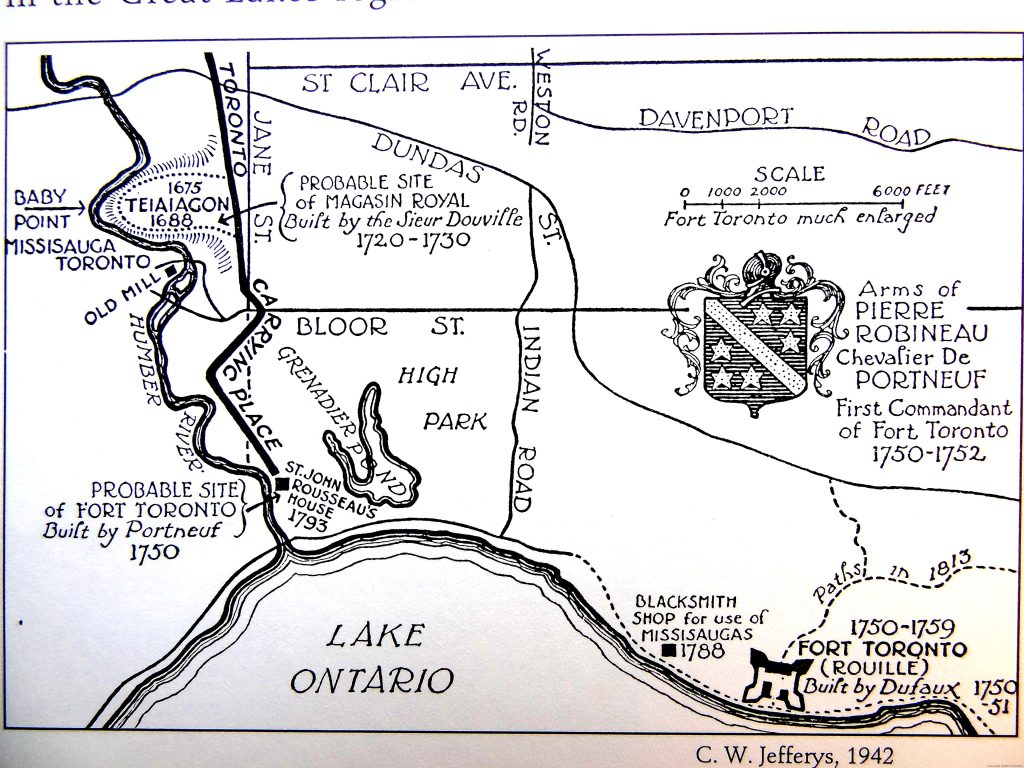
There were Robineau women in that founding generation too — Marie and Marguerite Robineau both came to the colony as Filles du Roi, the “King’s Daughters” sent to New France in 1668 to marry settlers and build the population (this is a fascinating topic that deserves it’s own blog post in the future). So, before my farmer-soldier ancestor Michel ever stepped off the boat around 1700, the Robineau name was already attached to governors, road-builders, and the founding of Toronto.
The Robineau name kept finding its way into the history books. André Jean-Baptiste Robineau-Desvoidy (1799–1857)was a French physician and entomologist who became quite famous for his work on Diptera — flies — and, to a lesser extent, beetles. A handful of Robineau’s turn up in the American Civil War (1861-1865) on both sides: a Peter, William N., and two John’s Robineau served the Union in regiments from the Veteran Reserve to the 5th Michigan Infantry, while a William F. Robineau served the Confederacy in the 52nd Virginia Militia.

My favourite of the bunch is Adelaide Alsop Robineau (1865–1929), an American china painter and potter widely regarded as one of the finest ceramists of her era. She married Samuel E. Robineau, who was from France, and together they ran the influential journal Keramic Studio. Her masterpiece, the Scarab Vase — also called The Apotheosis of the Toiler — reportedly took more than a thousand hours of carving and won a grand prize at the 1911 Turin International Exposition; in 2000 a magazine named it the most important piece of American ceramics of the previous century. And in a small twist that ties this catalogue of strangers back to the world of business, Adelaide’s son, Maurice “Bud” Robineau (1901–1966), founded the Frontier Refining Company. Born in Onondaga, New York, he died in Denver, Colorado — proof that the name had thoroughly crossed into the American story by the twentieth century.

There were Robineau’s near the levers of power, too. Georges Robineau served as Governor of the Bank of France from 1920 to 1926. Paul Robineau rowed for France at the 1928 Summer Olympics. And my own Michel Robineau dit Desmoulins (1683–1738) sits modestly in the middle of all of them — the first ancestor of my line from France, who arrived around 1700 with no title at all.
This is the thought I want to leave you with: Set them side by side and the Robineau’s are a deeply unlikely roll call. Governors of Acadia, the founder-by-proxy of Toronto, King’s Daughters, an entomologist, a celebrated ceramist, the governor of a national bank, an Olympic rower, soldiers on both sides of the American Civil War, and a French ex-diplomat doing twelve years in a Polish prison for spying behind the Iron Curtain. Not one of them, as far as I can prove, shares a drop of blood with me. And yet, I find I can’t help collecting them, the way you’d pocket interesting stones on a beach. A surname is a thin thread — but pull on it, and it runs through three centuries and half the world, from a fruit merchant’s stall near Saint-Roch all the way to a Cold War courtroom in Szczecin.
Which is, I suppose, exactly why I started digging in the first place.
References and further reading:
- Dictionary of Canadian Biography: http://www.biographi.ca/en/results.php/?ft=robineau
- Cheyenne’s 100-Octane Aviation Fuel Plant https://www.wyohistory.org/encyclopedia/cheyennes-100-octane-aviation-fuel-plant
Leave a Reply