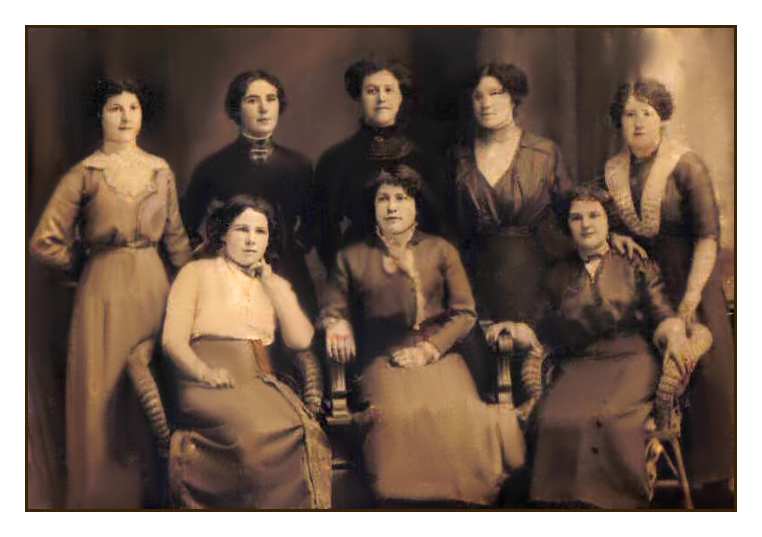
If the first chapters of this family story moved west across an ocean, the next ones move west from Lac des Deux Montagnes to Ripon, Quebec and to Sturgeon Falls. This is the story of the couple who began that westward drift: Joseph Robineau and his wife, Éléonore Farmer, with the surprisingly English surname.
Let’s get the dates on the table first because they anchor everything. Joseph Robineau was baptized on 8 March 1804. According to church records, his parents were Louis Robineau and Marguerite Bigras, who married in 1799 at Oka (L’Annonciation-de-la-Bienheureuse-Vierge-Marie). That places the family squarely in the seigneurie of the Lac-des-Deux-Montagnes, the patchwork of parishes spreading northwest of Montréal where land was still being opened to French-Canadian settlers. Éléonore Farmer was baptized on 26 August 1814; her parents were André Farmer and Marie Marguerite Cléroux. Joseph and Éléonore married on 20 February 1832 in the parish of Saint-Benoît.
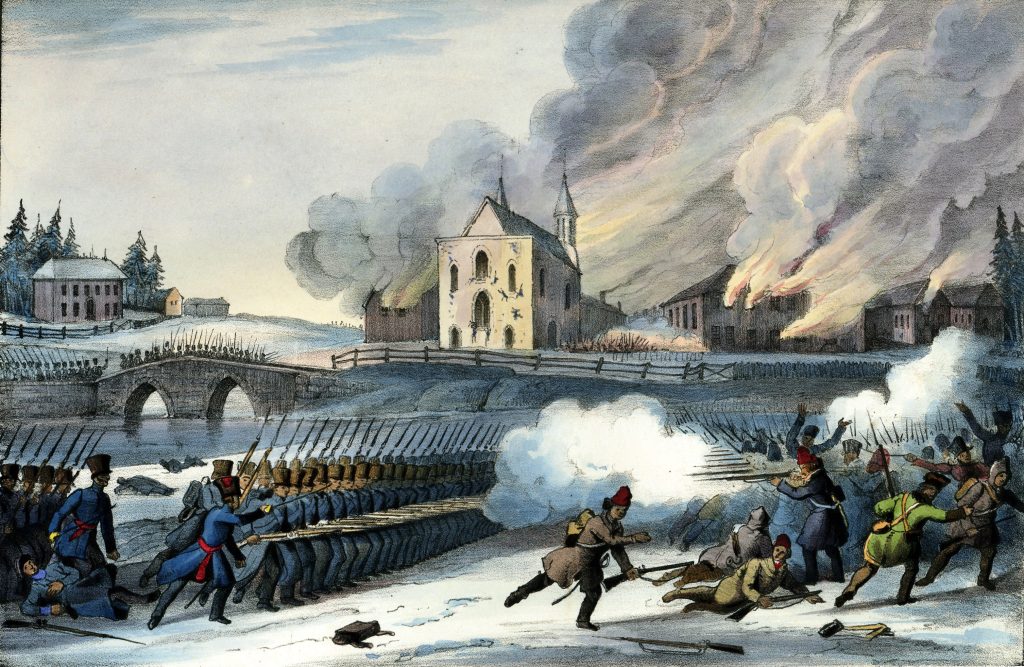
That parish name deserves a moment, because Joseph and Éléonore happened to settle in one of the most dangerous addresses in Lower Canada. Saint-Benoît sat in the county of Two Mountains, northwest of Montréal — in the autumn of 1837, that countryside erupted into the Lower Canada Rebellion. After the government’s victory at the Battle of Saint-Eustache on 14 December 1837, British troops under Sir John Colborne turned on the neighbouring villages. Two days later, on 16 December, Saint-Benoît was burned and pillaged. The Patriotes there had barely any firearms; the village was put to the torch largely without a fight.
Bataille de Saint-Eustache, 14 décembre 1837 lors de la rébellion des Patriotes à Saint-Eustache, ville du Québec qui se situe au confluent de la rivière du Chêne et de la rivière des Mille-Îles, dans la MRC de Deux-Montagnes et les Basses-Laurentides à 30 km à l’ouest de Montréal au Canada.
Lord Charles Beauclerk (1813—1842). Unknown Source, Public Domain.
Now check that against a single line from our family records. Among Joseph and Éléonore’s children was a “Joseph Robineau, baptized in 1836, died in 1837.” A child born into that parish, gone in the very year the soldiers came through. I cannot prove the two facts are connected, and infant mortality needed no help from any army in those years. But it’s impossible to read that birth-and-death in isolation once you know what was happening in Saint-Benoît at the time. Our ancestors did not watch the Rebellion from a safe distance. They were living in the middle of it.
The family name on Éléonore’s side carries its own small mystery. When I started in genealogy around 2010, her surname was a mess in the records — “Falmar,” “Phalmeur,” and other creative spellings abounded. The evidence now points firmly to “Farmer,” and there are even indications that Éléonore’s father may have come from Virginia. An English Virginian marrying into a French Catholic parish northwest of Montréal is exactly the kind of thread I would love to pull harder one day.
The 1852 Census of Canada East lists six Robineau children in the household — Émélie, Olivine, Joseph, Marguerite, Frédérique and Aurélie — living at Sainte-Marthe in Vaudreuil county, where they appear again in the 1861 census. Two children, Artémise and another Joseph, had died before 1852, and Damase, my great-grandfather, wasn’t yet born. Not much is known about the whole roster of children, but some scant additional details carry the story forward:
- Aurélie, baptized in 1833 married John Hughes at Sainte-Marthe in 1857,
- Frédérique, baptized in 1848, married Delphine Parent in 1869 at Ripon, and
- Damase, baptized on 1 August 1854, married Marie Riopel in January 1875, also at Ripon.
Notice how that town keeps appearing.
Joseph, the father, died in 1855, and his death opened a hard chapter.Unsupported sources (a phrase genealogists use when the story is good but the proof is thin) say Éléonore was left destitute. Joseph had apparently run a lumber business with his in-laws and when it failed the family lost everything. Éléonore was helped in raising her children by a man named Joseph Brunet, whom she eventually married in 1859. She lived a long time after that, dying in 1903 at the age of eighty-nine, having outlived her first husband by nearly half a century.
And finally, to the migration that gives this chapter its name. Beginning in the 1860s, the Robineaus drifted from the parishes around Montréal toward Ripon, in the Outaouais region of Québec. You can watch it happen in the marriage records: Frédérique and Damase both marry at Ripon in 1869 and 1875. The family had found new ground, and Ripon would matter enormously to what came next — it’s where my grandmother’s people lived and where her own story begins.
The drift didn’t stop there. In the early 1900s, Damase and his family pulled up stakes again and moved west once more, this time across the provincial line to Sturgeon Falls, Ontario. With that move, the family crossed out of Québec entirely and a French-Catholic line from the parishes of the Saint-Lawrence valley became, slowly, a Northern Ontario one.
It’s easy to read these names and dates as a dry list. But step back and the view is unmistakable: a couple married in a parish that was burned beneath them, a widow left penniless who rebuilt her life and lived to nearly ninety, and children who kept moving — Montréal, Sainte-Marthe, Ripon, Sturgeon Falls — always a little further from the river where the family started. They were frontier bound, in the most literal sense. Each generation packed up and pushed the family a little deeper into the country.The next two people in this story were born at the far end of that push.
Leave a Reply