By this point in his story, Michel Robineau has been baptized — around 1683, at Saint-Roch in Paris — and has picked up a borrowed name from a hill of windmills. Now comes the part I find hardest to picture: the day he decided to leave.
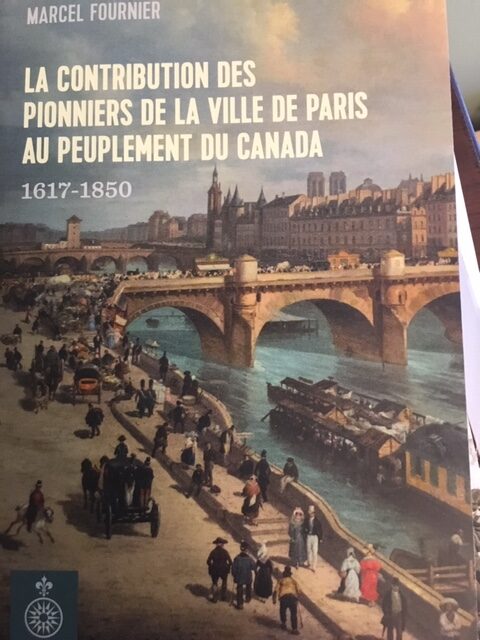
Some years ago, I bought a book with the wonderfully specific title The Contribution of the Pioneers from Paris to the Settlement of Canada. I bought it half-expecting to be disappointed and instead found our own Michel Robineau dit Desmoulins listed inside. The book confirms what I already knew and adds a few precious details. He was baptized in 1683 at Saint-Roch, a short walk from the Louvre. His parents were Simon Robineau and Anne Robineau (Larcher). By 1684 the family was living on a street in the Faubourg Saint-Denis, at the sign of the Cross of God in the Porte Saint-Denis neighbourhood — close enough to Saint-Roch to keep the two parishes within a comfortable walk of each other.
And then, in the early 1700s, Michel crossed the Atlantic to Montréal as a French soldier in the Compagnie de Manthet.
It is worth pausing on what that meant. Michel did not sail as a free settler chasing cheap land. He came as part of the troupes de la marine — the Compagnies Franches de la Marine, the colonial regulars who garrisoned New France after the famous Carignan-Salières Regiment had come and gone. These were companies of roughly fifty men, raised in France and shipped across to hold the colony’s forts, patrol its frontiers, and, when the fighting stopped, to settle down and help fill the country with French-speaking families. Soldiering and settlement were two phases of the same plan. A young man could arrive with a musket and a nom de guerre and end his days as a farmer with a houseful of children. That’s exactly what Michel did.
He married Marie-Louise Baron in Montréal in 1710. I look closely at that marriage contract in At the Edge of the Family Tree, because it turns out to be the single most important document in this whole branch of the family. For now, it is worth remembering what a marriage like that one represented: a soldier choosing to stay. The crossing from France was brutal — weeks at sea in cramped, unhealthy ships, with a real chance of dying before you ever sighted the Saint-Lawrence — and many who survived it eventually went home. Michel did not. He married a Montréal woman, took up land, and cast his lot permanently with the colony. The decision to remain was, in its quiet way, as consequential as the decision to leave.
Michel’s commanding officer in the army was a man named Louis Liénard de Beaujeu, and Beaujeu was a witness to Michel’s marriage contract. That alone is unremarkable — officers witnessed their soldiers’ contracts all the time. What stops me cold is this: Louis Liénard de Beaujeu was also born in Paris in 1683, the very same year as Michel.
Beaujeu, I should be clear, came from a very different drawer of society.He was born on 16 April 1683 into a noble family with the run of the royal court; his father was chef du gobelet de la bouche du roi, a household office close to the king himself. Beaujeu sailed for New France in 1697 to seek his fortune, took an ensign’s commission in the troupes de la marine in 1702, and rose to captain by 1711. He had a long and well-documented career and died in 1750. Michel, by contrast, left almost no trace beyond church registers and a marriage contract.
But here are two boys born in Paris in 1683 — one noble, one a fruit merchant’s son — who somehow end up on the same side of the Atlantic, in the same company, with the officer standing as witness while the soldier signs his marriage contract. Were they baptized in the same church? The records I have seen are tantalizing but not conclusive. Were they, against all odds, boyhood acquaintances who grew up in the same crowded quarter of Paris and decided, years apart or together, to go have an adventure in the New World?
I have no proof. Genealogy punishes people who fall in love with their own theories, and I have been burned before — see the entire windmill saga of the previous chapter. But I allow myself this one indulgence. I like to imagine that the distance between the noble and the soldier was smaller than the records suggest, and that somewhere under the unfinished vaults of Saint-Roch, two Parisians born in the same year crossed paths long before they crossed an ocean.
What’s certain is the shape of the journey. A child baptized in a half-built church, in a neighbourhood scraped flat to make room for a growing city. A young man who took the king’s musket and the king’s colonial gamble. A soldier who put down his arms in Montréal, married, farmed, and raised a family whose surname would scatter across Québec, across Ontario, and eventually across the whole country. Every Robineau in my line traces back through that one crossing.
From Saint-Roch to New France is only about five thousand kilometres of ocean. It’s also three hundred years of family, and it began with one soldier who said yes.
The book and biographical sources are listed under References and further reading below.
References and further reading:
- Fournier, Marcel. Contribution des pionniers de la ville de Paris au peuplement du Canada : 1617-1850. Éditions du Septentrion, 2018.
- “Louis Liénard de Beaujeu,” Dictionary of Canadian Biography: http://www.biographi.ca/en/bio/lienard_de_beaujeu_louis_3E.html
Leave a Reply